Friday, January 25, 2013

Horse Friends Forever!

This is a tribute to horse friends.

Not the barn full of friends in furry coats, ears eagerly pricked forward as I approach; no, this is to the legion of friends I've made because of, or through, or on the backs of horses.  It's a difficult post to write, because if I tried to properly acknowledge each of the hundreds of friends I've got thanks to our shared love of horses, it would be nothing  more than a list of credits rolling slowly across your screen -- so I must be cruel and select just a few to make my point.

That point is that horse friends seem to "stick" where other friends -- work friends, high school friends, neighbors -- seem to fall away as soon as you no longer work where they do, and have long since graduated, or have moved away.  Unless, however, there was also horsiness in common.  Those friends  seem to be as faithful as flies are to a barnyard -- but in a much nicer way, of course.

I'm well into middle age right now -- and many of my horse friends have ridden there with me.  My dear friend Cindy has done so for the past 38 years.  If our friendship was a horse event, it would be an endurance ride.   I still recall meeting Cindy in grade school and learning that she, too, was horse crazy.  Before long we were riding together, and not much longer still before we were doing crazy things on horseback -- meeting boys among them.  For every story I could tell on Cindy, though, she can tell one right back on me, so I'll avoid them (for now).  One thing I will say about Cindy is this:  somehow we still find new ways to sustain our horsey interests.  Recently Cindy joined us for an afternoon of ranch sorting.  I was amazed at the recognition that we were, once again, sharing a new riding adventure together -- decades after our first childhood rides.  It was Cindy I was riding with on the day that Elvis died; that thought always puts it into perspective for me -- our horsey friendship has marked many such historical, and personal, milestones.

Cindy is not only my horse friend of the longest duration, she's the horse friend who shared all the adventures of horse ownership with me -- the fun times and the challenging ones alike.  She's the friend who could be counted on to do "mare watch" with me (or for me, on the many nights I was working when a mare was due).  Many a night she spent in the barn with me, sprawled out on bales of straw with a flashlight in hand.  Many was the time she'd leave me that message, "No wax yet, Marce."


Through all of our thousands of hours side by side in the saddle, Cindy has greeted it all with her trademark good nature, sense of humor, and amused-but-pained expression at the predicaments I get her into.

When I was 17, I had the combined good fortune and misfortune of working at one of the premier Arabian ranches in the nation.  At the time, the "Arabian Industry," as it was called, was at its most lavish and opulent peak.  Not everyone I encountered was friend-worthy; there were definitely some co-workers at the ranch who weren't keepers.  But the ones I did keep are among the best friends imaginable:  Merrie and Denise.  Merrie has long been one of the nation's top riders and trainers; Denise has returned to horses again after a bit of an absence (just proving that horses aren't something you just give up -- they always seem to come back into your life one way or another).  

Merrie and Denise have long since left Arizona, and all our lives took dramatically different paths -- yet our friendships have endured.  They are the sort of amazing women that populate the horse world.  I could write chapters on the nooks and crannies of our unique, but interrelated, experiences with horses.

One interesting thing about horse friends is that they are often long-distance friends, but close in spirit.  There's Jim, in Oklahoma, whom I've loved talking horses with for years.  I'm thankful not just for his dear friendship across the miles, but for entrusting me with his very special horse Buck when it came time to sell him.  Horses bring great friends into our lives; horse friends often bring great horses into our lives as well.  Jerri, in Arkansas, became a friend when she saw a photo of my mare, Hollywood Royal Lady, on the internet -- and thought there was a striking resemblance to her own palomino gelding.  As it turned out, our horses are closely related, and our interests are, as well.  

Sometimes it seems each horse has brought a special person into my life with them:  after all, Chica brought me Sue.  Chica is a beautiful stinker of a horse; she's gorgeous and powerful, but she's a handful of a mare, and she was not an ideal family horse for Sue's family.  When I bought her, I was fortunate enough to not only acquire a mare that I love but a friend I adore.  Chica, for all your challenging ways, I will always owe you for that gift of friendship.

Horse friends are multigenerational, too.  Sue's daughter, Kelsey, is one of my younger horse friends.  Emily and Krissy are much-adored friends who were once my riding students when they were children.  Horses bridge the years.  One wondrous thing about them is that they give us the chance to ride with people outside our immediate sociodemographic niche.  I'm not much of a kid person, but the contact I do have with them is usually in the saddle or leaning on a rail.  

Not all my horse friends are female, of course.  One of my favorites happens to be my now-husband, Russ.  I met him on horseback.  We met on a 150-mile trail ride in New Mexico.  Who'd have thought a knight in shining armor would ride up on a horse named Chuck?  

Those long trail rides also brought me the treasure who is Beth.  Beth was one of those "friends at first sight" who soon became family.  Sometimes there's that immediate connection, just as there is with the horses we meet; it was also that way with Sharri.  Some friends are really sisters under the skin, and that's the only way to describe Beth and Sharri.  The afternoon I spent gathering cattle in Colorado with Sharri, and subsequent trail rides we've had here in Arizona, are highlights of recent years.  Beth and Sharri live in different states, but horse friendship knows no borders.

Our friend Tony visits us from Denmark, and we look forward to those annual rides together.  Horses are great ambassadors, and our big gelding Gus (above) enjoyed Tony's visit as much as we did.  

Not all of our horse-friends have ridden so many miles with us, though.  In the past year we were fortunate enough to meet Michael, Carolyn, Dale, and several other new friends through the cattle sorting events. Horse friends aren't limited editions; new, wonderful people continue to ride into our lives.  Times change, wrinkles accrue, and our horses come and go with lifespans all too short:  but horse friends are a constant.  In keeping with the text-speak of our time, I'll end with this:  HFF.  Horse Friends Forever.

Friday, January 18, 2013

What is it About Chasing Cows?

I don't know what it is about chasing cattle around that's so darned much fun.  Is it the speed?  (Not when I'm riding, it isn't.  My cow horses are pretty slow, actually.)  Is it the bovine psychology involved, and knowing exactly how to move them effectively?  Or is it something primal, visceral, in our DNA that hearkens back to a time when we had to pursue zebus around the cradle of civilization, stones and clubs in hand?

My husband and I are addicted to team sorting.  We're not particularly good at it -- we don't even compete.  We go to sorting practice most weekends, and we chase numbered cows from one pen to the adjacent pen.  Then we chase them back again.  Now, that might sound like a cowboy version of the old military exercise of digging a hole, then filling it in and digging another, but it's just darned FUN.  I really don't know why this activity, unlike any other team sport I've engaged in, has captured my interest so fully -- but it has me.

For those of you who don't know what team sorting is, but might have wondered why all those poor cows are running around with numbers on their backs, here's the scoop (or, since cattle are involved, we'll call it "the poop").  In team sorting (as opposed to single-person or single-man sorts) two riders enter a small round pen occupied by ten numbered cattle (0 - 9) and maybe an extra non-numbered cow or two.  In under a minute's time, the riders must bring each cow, one at a time and in order, from the first pen into an adjacent pen through an opening referred to as "the hole."  If a cow runs back into the first pen, or if they get out of order, the ride is disqualified.

I've always loved following a cow (or a herd of cattle) around on a horse.  I even had the wonderful opportunity to chase buffalo around on horseback one brief and shining summer when I was young.  Having the chance to do so weekly is making me feel like a kid all over again.  The horses love it; we don't push them to the point where they're angry and sour.  We want them to enjoy it, as we do.  We like that it makes them think, it challenges them, and that they look at is as a sort of game.

My good ol' girl, Hollywood Royal Lady, turns 26 in April.  From what I can tell, Holly had never seen a cow before the age of 25.    I had the brainstorm of taking her to the sorting.  She was apprehensive and unsure what those stinky critters were -- but suddenly she was lunging at the fence every time the cattle came by.  She loves chasing cows as much as I do -- and just as innately.  She pins her ears, trots along behind them, and moves sideways like a crab when necessary -- and it's instinctive.  Thanks to her breeding, she just knew how to work them.

Boot Scootin' Bandit, my beloved buckskin, was pretty burned out on anything having to do with cattle since his days as an arena roping horse.  Moving cattle from pen to pen, though, has restored his faith in bovine-dom.  Ol' Buck isn't as crazy about it as Holly, but he clearly is relaxed and happy when we're out there together.  Soon I hope all of our horses will be trained on cows -- just for the fun of it.  Standby when we take the half-draft half-gaited moose, Gus, for his first practice!  He's not exactly light on his feet.  At least he's big enough to cover the entire hole without moving.

If you're interested in teaching your horse how to sort, here's my article on horse-meet-cow to help you out:  Introducing Your Sorting Horse to Cattle.  If you live in the Phoenix area (or are looking for a great excuse to get away from the cold and enjoy our Arizona warmth), my friend Dale is hosting a cattle introduction clinic on February 17th, 2013, for sorting and penning horses.  It's aimed at those of you who've either never worked cattle, or who want to introduce your horse to cattle in a safe, slow, low-pressure environment, while having the benefit of some professional coaching and encouragement.  Here's Dale's email:  drdarnold@live.com.  The clinic is a very affordable $100 for four hours of instruction, mounted work, and one-on-one coaching.  (Auditors may attend for $20.)

While I'm singing Dale's praises here, I'll add that Dale takes horses in for training, too.  Those of you who know me know I won't recommend a trainer unless I know them to be patient, kind, non-abusive, honest, competent, and just all-around-good people.

Hope to see you in the sorting pen!

Saturday, December 29, 2012

An Open Letter to Craigslist Horse Sellers

It's a tough time to sell a horse.  I know that.  The market is appalling, and good horses are being sold at killer prices -- sadly, oftentimes to killers.  My heart bleeds each time I read the Craigslist ads and see some darned nice horses being marketed for months at ridiculously low prices.  My wallet bleeds, too, when I look out at a couple of my own nice horses that aren't selling.  It's just a rough time for the economy, and as goes the economy, so goes the horse world.

But much of the time when I read the local Craigslist ads, I get frustrated.  Frustrated because a lot of horse people are their own worst enemy when it comes to selling their horse.  For that reason, I'd like to offer a little bit of advice from a chronic reader of horse ads.  Please take it in the spirit intended:  I'd like to see good horses get a fair shot at a good home.  A few simple tips may help you write a better ad that will give your horse that chance.  This post is limited just to tips on writing your ad.  It doesn't even begin to go into detail about preparing your horse for potential buyers, and the conditioning, training, and other aspects of marketing.

First, provide adequate information.  Writing "female horse must sale" isn't going to have people knocking down your barn door.  At minimum, in the title of the ad, provide the basics:  age, breed, and gender.  The body of your ad should repeat the age, breed, and gender, and should also give a good overview of the horse's training level, soundness and condition, disposition, aptitudes, and good habits.  Indicate whether the horse is gentle or high-strung, and whether he's beginner safe, child-safe, or for an experienced rider.  Be honest.  If you're respectful of people's time and safety, you'll also advise of any bad habits or things that need some work.

Proofread your ad.  (By the way, it isn't "must sale," it's "must sell.")  If you have to, cut and paste from  your word processing program so you can run spell-check on everything.  It's not that you need to be a Pulitzer prize winning novelist to sell your horse; it's just that, as in everything, that first impression can make the difference in whether or not the buyer picks up the phone and calls you.  Marketing DOES make a difference -- why else do major corporations spend millions of dollars each year in advertising?

Be knowledgeable.  Don't advertise that your horse is "15.5 hands."  One hand equals four inches.  There IS no 15.5 hands; a horse that is 15 and a half hands tall is 15.2 hands, not 15.5.  If you don't sound as if you know what you're talking about, you're not going to have experienced horsemen come look at your horse.  Know the difference between a mare, a gelding, and a stallion.  One good friend and I like to swap bad Craigslist ads back and forth.  Some of them are priceless.  No matter how we laugh at the ones we've placed in our own Craigslist Horse Ad Hall of Shame, you know what? We won't go look at the horses in the really bad ads.  When it comes to selling a horse, not all publicity is good publicity.

Now here's what I'd really like to tackle:  the photographs you use.  A photo taken in a stall, looking down upon the horse who is eating hay off the ground while standing in the shadow, is worse than no photo at all.  Here are some ground rules for decent non-professional photographs:


  • Spend the time brushing or (gasp!) washing your horse beforehand.  Clip the horse if you have clippers -- at minimum,  clip the muzzle, bridle path, and back of the legs. If you don't know how to handle the clippers properly, have a friend do this for you.  You don't want Champion to have bad razor burns when you take his photo.
  • Brush his mane and tail.  If you've washed him, let him dry.  Photos of wet horses are a no-no.
  • If you have Show Sheen or other coat conditioners, use them.  You want your horse to shine and look healthy.
  • Use a leather show halter if you have one.  If you don't, or can't borrow one, use your best-looking barn halter.
  • Have an assistant hold the horse, or saddle him and tie him to a hitching post.  It's difficult and frustrating taking good photos of a horse unless you have someone to help -- unless you dedicate enough time that you can wait until Trigger strikes a good pose.  
  • If your horse is a purebred, have him posed appropriately for the breed.  For example, Saddlebreds should camp out in back, with their weight distributed primarily on the forehand; Arabians should stand with their necks stretched and arched, and one rear leg extended farther behind than the other; Quarter horses and paints should be squared up and photographed to emphasis their hips and hindquarters.  Please note that this is a very, very brief description.  Just know that you should know the breed of your horse and how that breed should be posed.
  • If you can't find someone to spend ten minutes holding your horse for the photo, and you decide to take photos of him loose in the corral, pick up the manure piles first.  Pick a good backdrop -- not the pile of junk in the corner of the yard, but a clean, uncluttered place.  Scenic views are better yet, but if you don't have that luxury, chose a location that is as simple and uncluttered as possible.  Posing him against some thick shrubs is ideal; the side of a tackroom is appropriate.  
  • Try to avoid having other horses in the photo.  No one appreciates those ads where there are four horses and you have to guess which one is for sale.  It's like seeing an online dating photo of four  men and wondering if the one you're corresponding to is the short fat guy holding the six-pack, or the hot dude standing beside him displaying his six-pack.  Disappointment is inevitable.
  • The photo should be taken at horse-level.  Don't sit on the rail and take the photo from above, even at an angle.  The best horse photos are at the level of the horse's body, not his head and not his feet.  Center yourself and crouch low enough to get the photo.  It's uncomfortable but it's good for your quads.
  • Horses grazing in a field are beautiful.  That's a great pose for a calendar.  It is a lousy pose for a sales photo.  When a horse extends his neck downward, you can't see anything about the way his front end is put together.  If your horse is eating, remove the food so you can get a better photograph.
  • Ears (the horse's, not yours) should be forward.  An otherwise great photograph can be ruined by a lackluster expression.  If you have an assistant, have them hold something interesting in front of the horse to get his attention.  Take LOTS of photos so you can select the right one.
  • If your horse is trained, get an action shot under saddle.  Show how he's stepping nicely over a log, or performing a sliding stop.  If he works on cattle or has been in a parade, those are great photos to show what he can do.
  • If the only tack you have is a rat-chewed bridle with a grazing bit and a faded fluffy orange bareback pad, take your picture without the tack.  Don't advertise your own amateurishness.  Let the buyer figure that out for himself.
  • I don't know how the trend started, but it seems that the thing every neighborhood "professional trainer" does to sell a horse these days is to stand up on his back.  For me, that doesn't do much.  I don't care if I can stand on a horse's back -- I care how he performs.  But if you want to be trendy, and your horse is broke enough to do it safely, go for it.  It must work, or so many people wouldn't be climbing up on their horse's back to demonstrate the latest party trick, right?  Don't get hurt for the sake of your photo!
  • If possible, include one full-body photo taken perpendicular to the horse to best show his conformation and condition.  Get the whole horse in it!  Don't lop off his feet, and don't pose him in weeds to hide what might be overgrown hooves or under-run heels.  Get another photo that plays up his best feature.  If he has a beautiful head, get a side shot of his head.  Please don't include photos of his head from the front.  That's not an attractive pose and does nothing for the potential buyer.
  • Get another shot from the front showing the legs (again, from the horse's level, not from above) and one from behind, also showing the legs.
  • Do remember the rule of outdoor photography:  have the sun to your back.  All of the above is meaningless if your horse is in the shadows and there's nothing but a silhouette.
  • Don't break any of the rules of horsemanship or horse care in your photo.  Don't show a horse with a gaping wound, or tied unsafely to a wheelbarrow, or trotting on the asphalt.  Don't show him being ridden badly.  If I see a photo of someone ripping a horse's head off with heavy hands, I'm not going to look at him unless I'm determined to rescue him from his private hell. 
Please do include a photo with your ad.  Few people are going to inquire about a horse without it, and those who do are going to ask for photos before they make the drive out there anyway.  If you can't figure out how to upload a photo, your credibility will take a serious hit long before your buyer talks to you -- if they ever do.  Some of us -- and I'm included in this -- won't EVER look at a horse when there's no photo in the ad.  Saying "ask for photos" is tantamount to saying, "Don't bother asking for photos.  Either I can't be bothered or I really don't want to show you what Old Blue really looks like because he's 200 pounds underweight and hasn't been trimmed in six months."  

Below is an example of an adequate non-professional photo of a horse.  I deliberately chose an average photograph, taken without the assistance of a helper, to show what can easily be gotten by the amateur. It is not a "great" photo.  It is a useful photograph, though, taken from an appropriate angle and showing the horse's build, expression, condition, and overall health.

Next is a bad example.  This photo does nothing for the buyer except show that the filly is flashy.  It doesn't show her lovely conformation, the pleasant way she moves, or the pretty head she has.  The tools in the background are distracting.


Here is another appropriate photo.  Again, this is not a great photo.  It's a backyard photo that shows the horse under saddle and stepping politely over a small obstacle.  Despite the branch protruding from my head, it has visual appeal.   The background is pleasant and the horse appears willing and happy.  You can tell a few things about the horse from this photograph.  This is a good angle for the picture.

Here, because bad examples are simply more fun, is another bad example.  This is an example of an interesting photograph that does nothing to help the viewer decide if the horse is worth seeing.  The viewer is left to decide which horse is the one that is for sale; the horses are wet and muddy; and out of three horses, not one is shown to any sort of advantage.  The only useful information to be gleaned from this one is that the horses apparently can be turned out together.  At least they've all been clipped.

Good luck marketing Buttermilk.  I sympathize with everyone who is trying to sell a horse in today's market -- and hope this helps in some small way with your own sales effort.

Wednesday, November 21, 2012

How to be a Horse Whisperer

Many people think that horse whispering is all about round pen work, and games you play with your horses, and non-verbal communication, and letting the horse decide when he is ready to do what you're asking of him.  In reality, that's just not it at all.  You can do all those things and turn out a great horse, but you're not a horse whisperer unless you do even more.  It's not all about the horse.

First, you have to have a good western name.  You'll never make it in the high-stakes horse whispering game unless you're named Cody or Montana or Dallas.  Myron, you don't stand a chance.  Mike and Bill, you'll have to work harder than the Shooter down the street.  Got a woman's name?  Give it up.  More on that later.

Next, you'd better have had a dad who walloped the ever-lovin' bejeezus out of you.  If your father wasn't a low-down, no good cuss who never showed you love so that your  life was an endless cycle of shallow and angry relationships until the day you realized you could whisper, you'll be limited in how far you can go.

You've got to look the part.  This means having your own signature hat:  whether it's an Aussie hat, or a Stetson, or a battered old Resistol with the front brim turned way down from getting face-planted on that "gentle" mare someone put you on, you'd best have a gnarly looking hat to show what a rugged individualist you are.  If you don't have an ample ring of ancient sweat expanding upward from the hat band, buy some fake sweat.  This is important.

Learn how to look your client in the eye and grow silent for a  moment before uttering a strikingly tender statement with a totally straight face:  "Yep, ma'am, you know horses are just big huge babies, and we have to look out for 'em."  Pepper your speech with down home truisms and meaningful pearls of wisdom -- and never, ever laugh at your own  jokes.  Try not to smile too much; you want to look perpetually wounded, but in recovery.

Buy yourself a half-dead stallion with the same troubled past you had (or that you've claimed you had).  Make sure you can stand on his back.  No horse whisperer is worth two bits if he doesn't routinely stand on his horse's back.  Heck, never buy a horse unless there's a photo of some cowboy standing on his back, for that matter!  Really, as long as you have that, you can count on it being a damned fine horse.

Hang your arm over that horse's neck, right behind his head, as if he's the one and only true friend you ever had -- and don't acknowledge him too much.  Make him out to be more of a body part of your own than a sole and separate horse.  Give him a down-to-earth,  unpretentious name -- Chuck, or Willie, or Merle.

Now, the important part:  get some testicles.  I don't mean, "Grow some balls."  I mean, if you aren't a lonesome cowboy -- not a lonesome cowgirl -- you'll only whisper to the occasional client; you'll never whisper to the masses.  It's not that you won't be downright great at what you do with the horses; it's all about the clientele.  No matter how great your battered old hat is, and no matter how many times you stand on your horse's back, you just can't compete.  Yes, Virginia, it IS a man's world.

You see, the  most important thing of all is that connection with your customers -- well, your fan base, actually.  Because it's not that you're going to be a great symphonic pianist:  no, a good horse whisperer is a rock star.  And rock stars depend on women.  Groupies.  Your groupies as a horse whisperer will be somewhat different than the groupies Justin Bieber has, but you'll need them just as Biebs does.

Your groupies will be the hordes of middle-aged women who've reached a wistful time of life.  They're reflecting on where they are now and where they used to want to be when they were twelve and where the heck their teenage figure went.  They're returning to the horses of their youth in hopes of regaining that youth right alongside them, and they're often afraid.  They've realized they're not immortal and they want wings once again, but they're afraid to fly.

That's where you come in.  It's not about the horse.  It's about giving horses back to your fans.  It's connecting with them through your connection with the horse.  It's about laughter and tears and disclosure and epiphany.  It's about rediscovery and personal journeys.  They may never get on a horse again -- but give them the hope that they will.

It's a wonderful thing, and it's important.   Next time you're out there standing tall on your old horse Waylon's back, look into those faces, cherish the opportunities they've given you, and give them back their wings.

(c) 2012 MJ Miller
All rights reserved

Friday, November 16, 2012

Oh, The Things They'll Get Into!


It's amazing, isn't it?  The tight spots that these huge, docile creatures can get themselves into.  Above is Smart Lil Sassypants, my yearling.  She looks pretty proud of herself, doesn't she?  She is, for the most part, a very pragmatic little girl, wise beyond her years.  In fact, while she was stuck in the position shown here, she decided she'd just nibble on the hay in front of her.  Hay, like grass, is always greener on the other side of the fence.

Yet, calm and smart as Sassy is, she still managed to get herself stuck.  That's the thing about horses:  they can find infinite ways to get into trouble.  Over the years, I've repeatedly heard the old horseman's adage about how you can put a horse in a rubber stall, and they'll still find a way to get hurt.  I can't argue.

I had one little mare who turned her head around in the old horse trailer I had, and managed to get the rail jammed underneath her jawbone so that she was wedged in that position.  I won't tell you how I got her free, because I know you won't believe me.  Another horse came out of the same trailer on a pothole-choked dirt road -- while it was moving.  The butt-bar and the door were both closed properly.  The vibration of the bumpy road managed to jar loose the friction-operated latch, and the horse leaned against the side of the trailer to support himself -- which caused the butt-bar to pop free on one end.  Somehow that darned Thoroughbred slipped through the 18-inch gap between the butt bar and the center post.   To my utter astonishment, he wasn't injured.  He had some missing hair on his hip and a scrape mark on one hoof.  Thankfully, he wasn't tied -- I went through a period of time when I didn't like tying my horses in the trailer.  It saved that one's life.  The trailer went up for sale immediately -- for landscaper use only.

It's not always the horse who risks injury with their strange ability to get into mischief.  I had just finished riding and rinsing one beloved gelding, Oscar, one summer afternoon.  I picked up his front foot to check for rocks, and just about jumped out of my skin.  There, neatly hanging out in the groove of his frog, was a perfectly intact, uninjured scorpion.  He wasn't smashed into the hoof -- he was just hanging on.  I nearly got stung by a scorpion that was in my horse's hoof.  Now, could anyone have predicted that one?

I can't count the times I've had to cut a horse out of a fence, or flip them back over when they got hung up against a stall wall.  The way to do that, if you haven't had that opportunity yet, is to loop a fat rope lead around the back legs, stand back toward the shoulder, and flip them.  Get out of the way fast once they start coming over, and let go of the rope when they do.  I've nearly had to cut one's halter off, when she rubbed her nose on the hitching post after I'd dismounted and caught her nose piece on the horseshoes welded onto the hitching post to make it easy to tie to.  I've never seen a horse get hung up quite like that before.  The hitching post will soon be modified to have those foolish horseshoes removed.  I'll never understand why someone made a hitching post that way.  Anything that protrudes from a fence or rail is just waiting for a tied horse to get hung up on it.

Then there's Ziggy -- MJ Royal Smartypants.  Ziggy, a stud colt, had the advantage for several months of being turned out with a very gentle gelding, Frosty.  I eventually had to separate them, as Ziggy was discovering his stallion-hood and continually trying to take advantage of sweet, defenseless Frosty (who couldn't kick due to instability in the hindquarters.)  Although I quit putting them in the turnout together, I kept them in adjacent stalls when they were in the mare motel.  Darned if I didn't come out one morning to find Ziggy in Frosty's stall, happy and quiet.  He'd managed to slip beneath the rails -- and there wasn't much room to squeeze through, but Ziggy did it.  He must have flattened himself like a hamster to slip through that narrow gap.

Guess what?  Ziggy is the proud father of Sassy, the little filly above.  Like father, like daughter.  Sassy's mother?  Well, she's the mare who got caught on the hitching post.  It's no wonder Sassy has a big chunk of missing skin from her forehead this week -- she's genetically prone to get herself snagged. There's not a sharp object anywhere near her stall; I can't even figure out what she happened to do to herself.  She's having more than her share of filly-hood bumps and bruises of indeterminate origin.  She's following in her father's hoof-steps already.

Thankfully, across all the years, none of my horses have had a really significant, life-ending injury from their solo antics.  Not for lack of trying, of course -- they find new ways regularly, despite my constant efforts to create a safe environment for them. They still manage to get hurt, despite the effort and planning -- horses just have a knack for that.  You just never know what they're going to find to get into trouble with.  

Here, though, are just a few common hazards:


  • Wire.  Wire fences, loose wire, wire that's exposed to them in any way.  Horses love to paw at wire and wedge it between their hooves and their shoes; they can find myriad ways to get stuck in it -- or stabbed by it.  If you've got wire fences, fasten it tightly to the rail at close intervals.  Nip off any protruding segments.  Consider anchoring it at ground level so a hoof can't slip underneath.
  • Gaps between fence posts.  Heads and legs easily become stuck.
  • Odd-shaped spaces in fencing, especially those that are narrower at top than at bottom.  Horses will pull their heads up as they're pulling back, so a keyhole shape is especially dangerous -- there may be plenty of room at bottom to free their heads, but as their heads rise, they become desperately stuck.  This can quickly become lethal, especially in younger horses.
  • Gaps in feeders, especially those with narrow rails, that a lower jaw can get caught in.  I've known at least two horses who shattered their jaws by getting hung up on rail-type hay feeders.  
  • Spaces beneath barn doors or partitions.  Horses can rip their hooves off when a foot gets stuck beneath a fixed object.
  • Halters left on the horse.  Here, again, I've known horses who died as a result of having their halters left on.  Under NO circumstances should a standard web halter EVER be left on a youngster unsupervised.  This is the equine equivalent of leaving a child alone in a pool.  Disaster is imminent.  Even adult horses get hung up -- but they aren't as likely to break their necks.  
  • Tying your horse to any object that is not fixed, solid, and heavy duty.  One of the ugliest set of injuries I've seen was to a beautiful mare who'd been tied to a wheelbarrow.  A wheelbarrow, folks!  That wheelbarrow chased that mare for miles through the desert when she took off running, and it still amazes me that she lived through her injuries.
  • Tying your horse to a gate.  Please, just don't.
Remember, always have your camera at hand.  Someday, I'll embarrass Sassy by showing these photos to her high-school prom date.  

Thursday, October 25, 2012

Oh, That Cute Little Spoiled Horse of Yours!

I know you love your horse.  I love my horses, too.  I'm not sure I love YOUR horse, though -- not your cute little spoiled horse, anyway.  I really dislike spoiled horses, and don't find anything cute about them.

Every so often I acquire a spoiled horse, either temporarily (one that comes in for training, for example) or permanently (one that I buy for myself) or semi-permanently (the occasional horse I either rescue, or I buy and rehab before selling).  Right now there are two spoiled horses here:  unmannerly horses that walk on top of the person beside them; race into and out of stalls without regard to someone standing at the gate; slam gates on people who are cleaning the stall beside them; and otherwise show no respect whatsoever for anyone two-legged.  They both get nasty when fed, and shove back when I'm putting feed in their feeder, and they kick at the stall walls when they aren't fed quickly enough.

They came to me together, and they have the same habits.  When I first rode them, neither one knew how to stand; one backed up and the other walked forward.  When I asked them to stand mid-ride, they fussed and fidgeted and moved around wherever they chose.  They both exhibited a little bit of stubbornness.  One humped his back a bit when I pushed him to do as I asked, and the other flat out refused and backed into thorny bushes.  As soon as I growled at them and told them to do what I said, they were fine and willing.  All these things are symptoms of spoiled horses.

Their previous owner loved them; I know that.  Most owners of spoiled horses do.  But like the overly permissive parent, owners of spoiled horses don't take responsibility for the future of their horses once those horses leave their own hand.  It is not a kindness to allow socially-unacceptable habits to develop in either our horses or our children.  Eventually, the animal (and I include those children in this word) pays the price for the lack of parental guidance.

It frustrates me no end when I have to discipline a horse because no one ever told them they shouldn't run their owner over.  It angers me when I have to be the bad-guy because a previous owner allowed the horse to rub its head on their back, or to dance like a leaf in the wind when I'm mounting.  It makes me feel sorry for the horse when I have to tell it, "No, Trixie, we don't smash our owners' hand against the feeder in the morning, and we don't slam gates on their shoulders when they're in the stall next door."  I don't like having to yell at the horse that thinks it gets to stop and eat whatever grows alongside the path I'm leading it by, and I don't like striking the severely (and dangerously) spoiled horse that strikes at me when I want to clip its muzzle or put fly spray on it.

I don't find it cute when I am at a student's barn and they giggle while the horse knocks them over, or when the horse grabs their pocket with its teeth because there might be a treat inside.  It's not amusing when the owner squeals with delight, "Oh, but look how CUTE he is when he does that -- how could you ever get MAD at him?"  Neither do I enjoy riding with them when the entire ride is a litany of, "Well, Zahar doesn't like water," or "Oh, Zahar will only go in front," or "Zahar has to trot out."  We shouldn't make excuses for our horses; we should make good citizens of them.

I know that spoilers of horses love them, and they believe they are being kind.  But now, more than ever, good and healthy horses are being starved, slaughtered, and abandoned because the economy is forcing a culling of sort.  You might not mind your spoiled horse stepping on you or your horseshoer, but you might not be able to keep that horse forever.  The buyer WILL mind, and will pass that cute little spoiled horse by for one that has proper manners.  Your cute little spoiled horse will be headed for mistreatment or slaughter.  (Just because the slaughterhouses in the United States don't kill horses anymore doesn't mean horses aren't shipped to Mexico, where less-humane methods of killing them are employed.  Don't fool yourself.)  That's how I came into the last two cute spoiled horses that are now here:  they wouldn't sell, and their next stop was going to be the slaughterhouse.  They are lovely animals; affectionate and healthy.  They are too nice to slaughter -- and too nice to spoil.

Horses are not poodles.  A 1,200 pound animal is too big to be a lapdog, and shouldn't be treated like one.  Miniature horses aren't particularly useful within the hierarchy of the performance horse world, but one wonderful thing about them is they make great pets that won't kill you when you spoil them.  If you have full-size horses, please instill in them respect for those around them.  It may save a life one day, and the life it saves may be their own.

Thursday, October 11, 2012

Why Do You NEED So Many Horses?

I have too many horses.  Yes, I admit it.  There are horses in every stall.  It's exactly what I've always wished for:  beautiful, happy, healthy horses filling the barn, and overflowing into the turnout pens.  Most days, one will greet you from the front round pen when you arrive.  I put the round pen on the hill by the driveway on purpose; I love to show them off.  They whinny when you arrive, and they call out again when you leave -- if you're lucky.

But there are too many of them.  I'm not a hoarder; I don't read on-line ads and make calls and just accidentally happen to see horses I can't resist.  I do breed a mare every now and then -- every two years (sometimes three) a foal arrives.  There are three generations on the property now; a 25-year old mare, her son, and his yearling foal, who is destined to be my next number one riding horse.  There are geldings, mares, a stallion.  A buckskin, some bays, a paint, some sorrels, a true black, and a palomino.  I like variety.

I do love walking friends and guests through the barn and introducing them to the herd.  I like pointing out the different personalities and idiosyncrasies and sharing each horse's life story.  I like showing how I train the horses to lower their heads on command, or step back on cue, or how the very special horses rest their heads gently on my shoulder.  I enjoy letting people meet the horses, sometimes the first time they've ever been so close.  This is what I've always wanted to do:  be surrounded by horses and spend hours every day caring for them, training them, riding them, and yes, cleaning up after them.

But what I don't like is a particular question.  I'm sure I'm not the only one who gets asked this; I'm sure anyone who has horses, in the plural, gets asked the same thing.  I get defensive when I'm asked, and sometimes I'm snappy like a petulant terrier when I answer.  It never bothered me when people would ask, "Why aren't you married yet?"  (I fixed that particular issue over a year ago.  Late bloomer, I guess.)   It never bothered me when they'd ask, "Why don't you have kids?"  But this question -- THE question -- sends me into instant annoyance.

"Why do you NEED so many horses?"

The problem with THE question is that it's so laden with judgment.  It's not a question a horse lover will ask another  horse lover; we just understand.  It's a question the non-horseman asks, and they aren't asking it because they will ever understand.  They're asking it because they want you to know that they don't approve.  The answer is irrelevant.

It's not a question they ask because they're concerned about the condition of the horses.  Anyone can look at these animals and see that they're well fed.  Their hooves are trimmed or shod.  They are wormed regularly.  Each one is turned out over 12 hours a day -- and most of them are turned out at all times.  They have shade.  They have vet checks twice a year, and all of them who are riding age are trained under saddle.  These are not neglected animals.  Each one (other than my husband's horse, and that's because he adamantly refuses to let me do so) is neatly clipped every week.

The stalls are cleaned a few times a day.  Sometimes it's only twice a day, but other times it's a half dozen times.  The horses are fed abundant food, appropriately tailored to their specific needs.  They get exercise.  They have an excellent social life, and they have deep bedding in their stalls.  The youngsters know what youngsters ought to know:  they load, they tie, they pick their feet up politely, they stand to be groomed, and they allow their faces and ears and legs to be clipped.  Fly spray doesn't bother them.  They're good about being wormed, and vaccinated, and trimmed.  The two fillies on site have been ponied.

But there are too many.  A few of them are for sale, but they require either healing or retraining.  I don't want them going to a home where they may be injured or may cause injury.  I don't want them going to Mexico to slaughter.

Some, I'll never sell.  The numbers in my barn are at an all-time high now.  (Since I know you're wondering, suffice it to say there are fewer than a dozen, but more than half a dozen.)  I didn't go looking for them; they just -- well, they just happened.  As I give the tour of the herd, I tell the story of Gus and Shiloh.  They were rescues.  Their owner loved them and provided well for them, but was at wit's end when things crumbled personally.  She couldn't sell them; the market had crashed, and these out-of-shape horses could not compete with the sound, well-conditioned horses flooding the market.  They were too nice to be sent to slaughter.  I stepped in.  One is recovering from lameness so severe she wouldn't even stand the first weekend I brought her home; she just stretched out on her side because her feet hurt so badly.  The other is learning his manners.  He's spoiled, but sweet.  He's getting back in shape and getting lots of miles on the trail.  They're for sale, but until the right home comes along, they have a safe haven here.

There's Holly.  She's the matron, at 25.  She is here for life.  She's always had good care and great owners, and was never treated badly, but she has had eight homes in half as many states.  She's lived in Wisconsin, Indiana, Minnesota, and Arizona.  Even if I didn't love her wholeheartedly, which I do, I would never sell her.  She deserves a forever home -- a stable stable, so to speak.  Recently, after her 25th birthday, I began ranch sorting on her, and she might as well have been a two year old; she loves it, and can't wait to chase the cows.  Holly is a prim and proper mare with a great sense of mischief.

There's Holly's son, Ziggy.  Holly was carrying him when I bought her.  He's the big guy now, the stud horse.  In a fit of madness when I was dealing with a family illness, I sent him to a "trainer" to continue the gentle training under saddle I had started.  The trainer brutalized him.  This kind, gentle, sweet-natured stallion came back a beast.  It has taken two years to get him back to his happy, playful self.  He's mine forever; I won't risk letting someone else torture him out of fear, or machismo, or short-man's syndrome.  He's another keeper.

There are others.  There's my best riding horse, Buck.  He's the horse of my heart; I adore him.  He has the biggest heart of any horse I've ever known, and is as honest as a horse can be.  I trust him completely, and I ride him more than any horse here.  I wouldn't sell him at any price.  When we're young, we horse-crazy girls have a vision of our dream horse.  He's that vision I had:  a big, solid buckskin with kind eyes, so warm and sweet they remind me of melted chocolate.

There's the little bay mare.  Before I got her, she'd been abused.  She's so head shy that even now if you move too quickly, or worm her, or touch her ears, she over-reacts and flies backwards in terror.  She's coming along nicely, and she's got a lightness of expression she never had before.  When she's completely reliable under saddle, and has learned a bit about working cows, she'll be for sale -- but not until the right rider finds her.  She'll stay here until that happens.  It might be next week, or it might be never.  But she's a sweet little girl and doesn't deserve to risk abuse again.

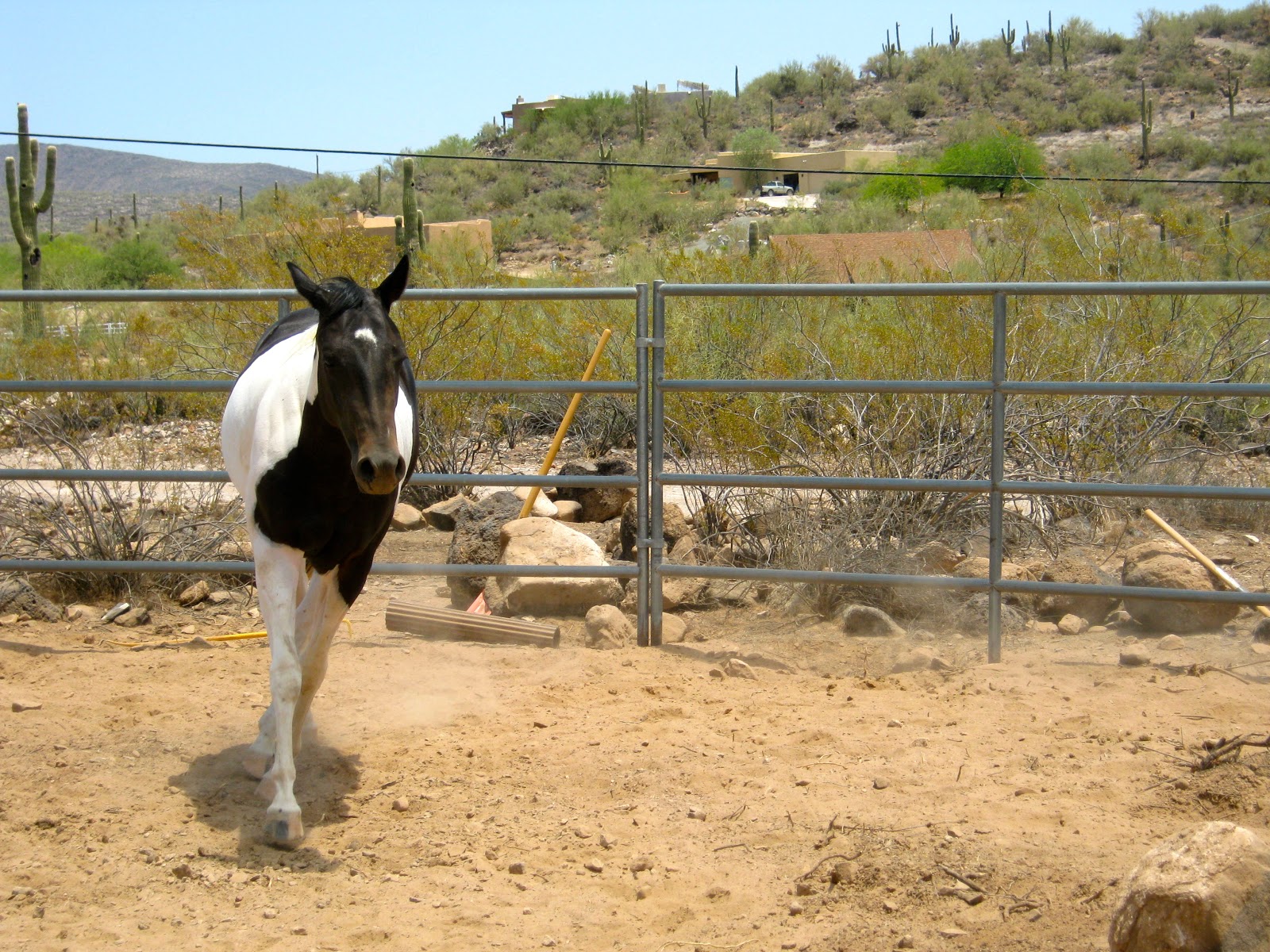
When she was on her way to me, after I'd agreed to buy her from a friend (not the one who'd handled her roughly), I learned she was in foal.  That meant another baby.  That plain-brown-wrapper mare foaled a flashy, black-and-white paint filly.  Meet Bisbee:  sweet, affectionate, but sensitive.  She's quick to move, but takes patience to train.  She's for sale, but you can probably already guess:  not until the right owner comes along.  She's about the prettiest little paint  you ever saw, but she needs just the right hand to train her.  She's not as resilient as some horses, and needs completely gentle handling, or she crumples like a wet tissue.  The right person will make her into a barrel horse, where she can use her speed and agility and endless energy.  Until then?  Yep.  Here she is.


Yes, there are too many.

I quit answering THE question a few months back.  I am blunt about it now; abrupt, even.  I say, "I don't answer that any more.  It's a judgment-filled question."  The neighbor asked it when he ventured over to introduce himself; he doesn't like horses.  Friends with poodles ask it.  Visitors with fifteen cats walking around on their countertops at home ask it.  Horse people?  They just understand.

What I want to say to those who ask is, "Why is it about need?"  The prankster in me is tempted to ask why they needed five children, or a flat-screen TV, or the latest Apple gadget -- after all, their last four iPhones still work fine, and I could have bought a lot of hay with the money they spent.  Do they need a Hummer, or a cabin in the woods?  Do they need a garage filled with vintage Indian motorcycles, or that boat in the driveway?  Here's the thing:  we don't often need what truly makes our heart sing.  Not in the physical sense, anyway.  We can live without the art collection, or the dog at our feet.  We can live without the creative pursuits that awaken us intellectually, or the scented candles that stimulate our senses and evoke a restful place.

No, I don't need this many horses.  I can do without them, and, in all likelihood, they can do without me.  It's not about need, though, is it?  We don't write love songs about the air that we breathe or the water we drink.  Shakespeare's sonnets aren't about the blood that runs through our veins, or the heart that pushes it:  they're about the things that make our blood heat up, and our heart beat faster.  The things that make our life full and rich are the things that we don't need.  The stuff of poetry and art is non-essential to our existence, and oh-so-critical to our fulfillment.

I have a barn full of horses I really don't need.  They're like my dogs:  it's not that I can't live without them; it's that I'd never want to try.


Do I Really NEED This?

(c) 2012 MJ Miller 
No part of this content may be reproduced without the written permission of the author.  All rights reserved.